

For years, IT systems have followed a predictable pattern—data is generated at the edge, sent to centralized clouds, processed, and then returned as insights. It worked well enough when speed demands were moderate and data volumes were manageable.
- The End of Centralized Thinking in IT
- 6G Is Not Just Faster—It Changes What’s Possible
- Why Processing Location Matters More Than Ever
- The Real Breakthrough: When Connectivity and Processing Merge
- From Reactive Systems to Real-Time Systems
- How Enterprise Architecture Is Quietly Changing
- The Impact on Real-World Systems
- Security and Complexity: The Trade-Off
- What This Means for the Future of IT Strategy
- Conclusion
That model is now under pressure.
As applications become more real-time—autonomous systems, immersive environments, AI-driven decisions—the distance between data and action is becoming a bottleneck. The future of IT is no longer about where data is stored, but about how fast it can be understood and acted upon.
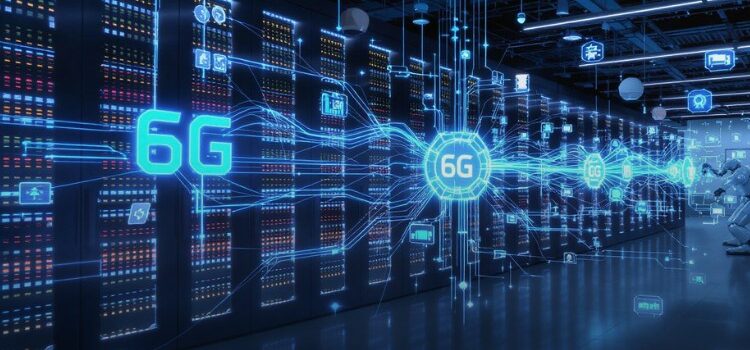
This is exactly where the combination of 6G and Edge Computing begins to redefine everything.
The End of Centralized Thinking in IT
Traditional IT infrastructure was built on centralization. Data centers handled processing, and networks simply transported information back and forth.
But as digital ecosystems expand, this approach is showing cracks.
When milliseconds matter, sending data across long distances introduces delays that systems can no longer afford. Whether it’s a machine making a decision or a system reacting to user input, latency is becoming the biggest limitation.
The shift now is toward decentralization—not as a trend, but as a necessity.
6G Is Not Just Faster—It Changes What’s Possible
Each generation of connectivity has increased speed, but 6G introduces something more fundamental: ultra-responsiveness.
We’re moving into a world where networks are no longer passive carriers of data. They become intelligent layers capable of adapting in real time.
With near-instant communication:
- Systems can respond without delay
- Devices can coordinate without interruption
- Data flows become continuous rather than staged
This changes the role of the network—from infrastructure to active participant in computing.
Why Processing Location Matters More Than Ever
While speed solves one part of the problem, location solves the other.
Edge computing brings processing closer to where data is generated. Instead of sending everything to a distant cloud, decisions are made locally, instantly.
This shift creates a new architecture:
- Immediate decisions happen at the edge
- Complex analysis still happens in centralized systems
- Both layers work together seamlessly
The result is not just faster systems—but smarter ones.
The Real Breakthrough: When Connectivity and Processing Merge
Individually, 6G and edge computing are powerful. Together, they create a system that behaves differently.
6G ensures that data moves instantly across networks.
Edge computing ensures that data doesn’t need to move far in the first place.
This combination removes traditional delays from both ends.
What emerges is a system where:
- Data is processed where it is created
- Insights are generated in real time
- Actions happen without waiting
This is not an upgrade. It’s a structural change in how IT systems function.
From Reactive Systems to Real-Time Systems
Most current IT systems are reactive. They process events after they occur.
Next-generation systems will be real-time by design.
This means:
- Decisions are made as events happen
- Systems adapt instantly to changes
- Responses are continuous, not delayed
This shift has deep implications for industries where timing is critical.
How Enterprise Architecture Is Quietly Changing
Organizations are no longer building systems around a single core infrastructure. Instead, they are creating distributed environments.
Central clouds still exist—but they are no longer the only processing layer.
Enterprises are adopting:
- Hybrid architectures
- Distributed processing nodes
- Real-time data pipelines
This creates flexibility. Systems can scale, adapt, and operate independently while remaining connected.
The architecture becomes more modular, more resilient, and more responsive.
The Impact on Real-World Systems
This transformation is already influencing how systems are designed across industries.
In environments where timing is critical, delays are unacceptable. Systems must process, decide, and act instantly.
This applies to:
- Intelligent transportation systems coordinating in real time
- Industrial environments optimizing operations continuously
- Healthcare systems responding instantly to live data
In all these cases, the combination of speed and proximity defines performance.
Security and Complexity: The Trade-Off
With distributed systems comes increased complexity.
When processing moves away from centralized control, managing security becomes more challenging. Each node, each connection, each interaction adds a layer of responsibility.
Organizations must rethink security as a distributed function—not just a centralized one.
This includes:
- Securing data at multiple points
- Monitoring activity across systems
- Ensuring consistency in policies
The challenge is real—but so is the opportunity.
What This Means for the Future of IT Strategy
The shift toward 6G and edge computing is not just technological—it’s strategic.
Organizations will need to rethink:
- Where data should be processed
- How systems should be designed
- What level of responsiveness is required
The goal is no longer efficiency alone.
It’s immediacy.
Companies that adapt early will build systems that are faster, smarter, and more competitive.
Those that don’t will struggle with delays that modern applications can’t tolerate.
Conclusion
IT systems are entering a new phase—one defined not by storage capacity or processing power alone, but by speed of understanding.
The combination of ultra-fast connectivity and localized processing is removing traditional barriers between data and action.
This is not just an evolution of infrastructure.
It’s a redefinition of how digital systems operate.
Because in the next generation of IT, the advantage will not go to those who have more data—
It will go to those who can act on it instantly.